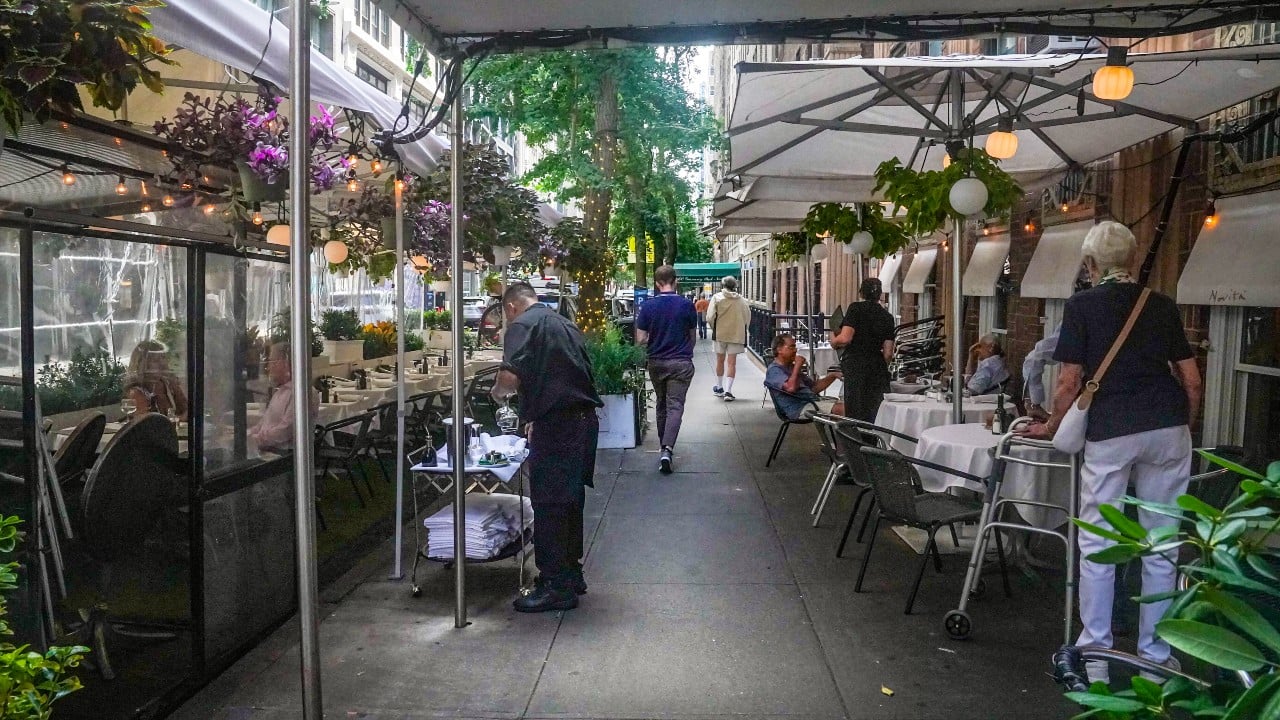
"The city fines took effect November 1 and it's a $500 a day fine every day we keep it up."
That was Bruce Horowytz, owner of 44&X on Tenth Avenue at West 44th Street, explaining to a Hell's Kitchen news outlet in late 2024 why his restaurant's roadway shed had to come down. A few blocks north, workers were doing the same thing to Dolly Varden's train-car dining structure at 302 West 51st, the railway-themed setup that had greeted the neighborhood since March 2021. Both teardowns happened under a rule that forced roadway cafes to come down every fall and stay gone until spring, with fines for anyone who didn't clear out fast enough.
That rule is dead now. On August 31, 2026, Mayor Zohran Mamdani signed Local Law 135, killing the seasonal teardown mandate for good. If you live in Hell's Kitchen, Chelsea, or anywhere else in Manhattan where a restaurant built out street seating in the last few years, this is the first winter since the teardown mandate started biting in 2024 that seating doesn't have to vanish. But the version of outdoor dining coming back this winter is not the version that got torn down. The eccentric, semi-permanent builds that made certain corners memorable, the train car, the wraparound wood structures, aren't what the new law is designed to protect. What's coming back is leaner, code-compliant, and explicitly temporary. Understanding that difference is the actual story here, not the headline that dining is "back."
What Changed on August 31
Local Law 135 amends a 2023 rule that required restaurants in the Dining Out NYC program to dismantle roadway cafes between November 30 and March 31, a requirement that never applied to sidewalk cafes in the first place. Council Member Lincoln Restler sponsored the bill, and the Mayor's Office statement framed it as removing a cost that fell hardest on small operators: tearing down a structure, paying to store it, then paying again to rebuild it every spring. The law took effect immediately upon signing.
Going forward, the city is creating two separate license tracks for roadway cafes: a seasonal license for restaurants that still want the April-to-November structure, and a year-round license for those that want to keep serving outside through winter. Existing operators with an active roadway cafe can apply for a one-year interim license to bridge them through this coming winter specifically, at a cost of $630 on top of whatever they're already paying for the underlying roadway permit.
The Fine Print That Actually Matters This Winter
If you're the kind of resident who actually uses these setups, here's what's different on the ground, not in the press release:
- Applications for the new year-round roadway license opened in early September 2026, which means some restaurants simply won't have approval in hand before the cold sets in. Don't assume every shed you remember reappears by December.
- Closing time for roadway cafes and most sidewalk cafes is now 11 p.m., an hour earlier than the midnight cutoff under the prior rules. The Department of Transportation cannot loosen this later through regulation.
- Sidewalk cafes, which were already permitted year-round, can now legally add removable vertical winter coverings for the first time, meaning a table that used to be exposed to wind on Ninth Avenue can be partially enclosed this January.
- Cleanliness rules got sharper, not softer. Restaurants face civil penalties starting at $200 for a first offense and climbing to $500 for repeat violations involving trash, graffiti, or vermin. Furniture must stay removable and lightweight, and floorboards still have to come up weekly for cleaning underneath.
- Restaurants can now pay their annual licensing fees in quarterly installments instead of one lump sum, which matters less to you as a diner but explains why more small operators are likely to actually participate this time.
Manhattan Is Where This Actually Plays Out
This isn't an evenly distributed change. A recent analysis by the nonprofit Open Plans, reported by Gothamist, found that 94 percent of the city's curbside dining setups sit in Manhattan and Brooklyn. Whatever this law does to New York's streetscape, it does it here first and most.
That concentration also explains why the drop-off hit so hard under the old rules. At the pandemic's peak, the city had nearly 12,000 sidewalk and roadway dining setups combined. As of this past summer, before the year-round law passed, that number had fallen to roughly 1,800 citywide, split between about 500 approved roadway cafes and 1,300 permitted sidewalk cafes, according to Department of Transportation figures. Most of that collapse happened on Manhattan blocks, because that's where most of the setups were in the first place. The seasonal teardown didn't just inconvenience restaurants generally. It specifically hollowed out the borough that had built the most infrastructure around outdoor seating.
The Sheds That Aren't Coming Back
Here's the part that gets lost in coverage that treats this as a simple reversal. The old emergency-era sheds, the ones people actually got attached to, were often closer to small buildings than temporary furniture. Dolly Varden's train car wasn't a folding table with an umbrella. It was a themed structure, and when W42ST covered its demolition in late 2024, the outlet noted the design that eventually replaced it likely wouldn't recall "the days of 1920s train travel" the way the original had. That prediction held. The restaurant at that same 302 West 51st address now operates as Dolly's, a rebrand that landed after the shed came down.
Compare that to Lovely's Old Fashioned, at Ninth Avenue and West 45th, which in August 2024 became one of the first restaurants in the city to build to the Department of Transportation's new approved specifications: open sides, a slanted plexiglass roof, and a structure designed from the start to be stored off-site every winter. That's the template Local Law 135 is actually extending, not the train car. The law's language permits "readily removable vertical winterization coverings," which is regulatory phrasing for temporary panels and enclosures, not permanent construction. A restaurant can now leave that kind of structure up through the cold months instead of storing it, but the structure itself still has to be built to come down.
So the honest version of this story is that year-round outdoor dining is legally back, and the era of idiosyncratic, semi-permanent street architecture is not. What returns to Hell's Kitchen and the rest of Manhattan this winter will look more uniform than what disappeared in 2024, because the rules that survived the political fight are the ones written for removable, code-compliant setups, not the ones written for a train car.
What You'll Actually See This Winter
If your regular spot had roadway seating before 2024 and wants it back for this winter, expect a version that's lighter, more standardized, and possibly delayed if the paperwork isn't finished. If your spot only ever had sidewalk tables, expect the option of a partially enclosed setup for the first time, assuming the restaurant applies for the winterization allowance. Either way, the enforcement side is real: uncleaned setups now carry named fines, and the 11 p.m. cutoff is fixed in the law itself, not left to future rulemaking.
None of this restores what Hell's Kitchen had at the pandemic's peak. It restores a narrower, better-supervised version of it, concentrated in the borough that already had the infrastructure to use it. For a neighborhood where sidewalk activity and ground-floor retail health are tied together block by block, that's not a small distinction. It's the difference between a rule change and a rebuild.
If you're watching how policy like this shapes the blocks you live and invest near, that's exactly the kind of read Tide Realty Group tracks across Manhattan and the other boroughs we work in. Rise With Us.


