If you look at Queens as one retail market, you miss the story. The borough works more like a network of neighborhood business districts, each shaped by its own transit access, street design, customer base, and storefront format. If you are tracking retail leasing, acquisition, or tenant expansion in Queens, understanding those corridor-level differences can help you spot where demand is durable and where a concept is more likely to fit. Let’s dive in.
Why Queens retail is hyperlocal
Queens County had an estimated population of 2,358,182 in July 2025, and 47.6% of residents were foreign-born. That helps explain why many of the borough’s strongest retail streets are multilingual, neighborhood-driven, and built around repeat local visits instead of occasional destination traffic.
From a planning perspective, Queens includes both neighborhood-serving commercial districts and larger regional centers. In practical terms, that means a corridor in Flushing behaves very differently from one in Bayside or Astoria, even though all sit within the same borough.
For owners, landlords, and tenants, the takeaway is simple: retail strategy in Queens is block-by-block and corridor-by-corridor. The best opportunities tend to show up where transit access, residential density, and walkable public space overlap.
Downtown Flushing stands out
Downtown Flushing is Queens’ clearest regional, transit-first retail node. Main Street and Roosevelt Avenue anchor the district, with support from the 7 train, the Long Island Rail Road, Select Bus Service, and nearby highway access.
The city’s neighborhood assessment describes Flushing as having the heaviest foot traffic outside Manhattan and more than 20 public transportation options. That kind of volume supports a dense mix of restaurants, financial institutions, beauty and personal care, specialty food, clothing, electronics, pharmacies, and professional services.
Flushing also works across multiple retail formats. You see street-facing storefronts, upper-floor service uses, and multi-level shopping centers, which gives the corridor flexibility for both smaller local operators and larger mixed-use retail environments.
Why Flushing matters
For retail users, Flushing is strongest when the business depends on steady repetition and broad draw. Specialty food, quick-service dining, telecom, banking, beauty, and medical or dental uses tend to match the corridor’s traffic patterns well.
For landlords and investors, the lesson is that constant movement matters more here than novelty. Retail concepts that rely on convenience, frequency, and visibility are generally better aligned than lower-frequency destination uses.
Jackson Heights rewards foot traffic
Jackson Heights is one of Queens’ strongest mixed-use retail districts because it combines dense local commerce with unusual transit reach. The corridor network includes 37th Avenue, Roosevelt Avenue, Broadway, 72nd through 77th Streets, and 82nd Street, all supported by five subway lines and seven bus routes.
The neighborhood’s retail base is broad and deeply local. Restaurants, specialty food, banks, money transfer services, laundromats, hardware stores, pharmacies, beauty shops, apparel, electronics, groceries, and general merchandise all appear across the corridor mix.
Pedestrian counts help explain the corridor’s staying power. The city recorded 8,450 pedestrians on 82nd Street between 37th and Roosevelt during weekday afternoons, plus 6,170 on weekends. On 37th Avenue between 73rd and 74th Streets, weekday afternoon foot traffic reached 4,375 pedestrians.
Why Jackson Heights matters
Jackson Heights works best for culturally specific retail, quick-service dining, beauty, convenience goods, and neighborhood services that benefit from all-day sidewalk activity. Raw transit access is important, but storefront visibility and street conditions matter too, especially along stretches under the elevated train.
That creates a useful filter for site selection. In Jackson Heights, the right corner, frontage, and pedestrian flow can matter as much as the corridor name itself.
Astoria offers multiple retail plays
Astoria is not a one-street market. Its retail strength comes from several overlapping corridors, including Steinway Street, Broadway, Astoria Boulevard, Ditmars Boulevard, 36th Avenue, and 30th Avenue.
The neighborhood assessment describes Astoria as home to residents from more than 80 countries, with a strong concentration of restaurants, cafés, coffee shops, and specialty food stores. Steinway Street remains especially notable, with Queens Community Board 1 calling it the longest retail shopping street in New York City, while the Steinway Street BID lists 338 ground-floor retail businesses.
Street design improvements also reinforce Astoria’s walkability. On 31st Avenue, the city reported that 53% of daily trips are on foot, 34% by bike, and 11% by car, alongside more than 26,000 square feet of new pedestrian space.
Why Astoria matters
Astoria is well suited to restaurants, cafés, fitness and wellness, personal services, and neighborhood comparison shopping. The opportunity here comes less from one dominant anchor and more from a walkable residential base that supports frequent visits.
For investors and landlords, Astoria shows how a multi-corridor district can spread demand across several connected streets. That can create resilience, especially for operators who benefit from local loyalty and repeat traffic.
Jamaica is driven by transit scale
Downtown Jamaica functions as one of Queens’ biggest transit and civic hubs. The city says roughly 560,000 people pass through daily, supported by four subway lines, 48 bus routes, the Long Island Rail Road, and AirTrain JFK.
That scale shapes the retail mix. Jamaica Avenue combines national and local retailers, while Hillside Avenue includes auto-related businesses, restaurants, and service uses, and 165th Street Mall operates as a pedestrian area with small businesses and the Jamaica Colosseum Mall.
The corridor inventory shows a strong service and value orientation. Clothing, shoes, beauty and barbering, limited-service restaurants, medical services, electronics, jewelry, furniture, and general merchandise all play a role in the district.
Why Jamaica matters
Jamaica is a strong fit for value retail, family dining, banks, medical uses, and high-turnover service concepts. It is one of the clearest examples in Queens where transit volume, not just neighborhood identity, drives leasing potential.
Hillside Avenue is especially worth watching. NYC DOT’s 2025 bus-lane project is designed to improve service for more than 215,000 daily riders across 22 bus routes, reinforcing the corridor’s appeal for bus-dependent retail and services.
The district also continues to see major investment. The city’s assessment cites more than $1 billion in public investments, 4,800 new apartments, 2,400 hotel rooms, and 500,000 square feet of commercial space completed or pending.
Forest Hills keeps its shopping identity
Forest Hills offers a different kind of retail story. Austin Street stands out as a more polished, comparison-shopping corridor, with a mix of small shops, chain stores, and restaurants.
NYC Planning’s Special Forest Hills District specifically aims to preserve, protect, and promote the special character of Austin Street as a regional shopping destination. Transit access remains strong too, with nearby E, F, M, and R service and the Forest Hills Long Island Rail Road station just south of Austin Street.
The city’s Neighborhood 360° program has also identified Forest Hills as an FY2027 grant focus. That signals continued public attention to corridor improvements and pedestrian-oriented commercial conditions.
Why Forest Hills matters
Forest Hills tends to fit chain or hybrid tenants, sit-down dining, personal care, specialty retail, and comparison-shopping uses. For users seeking a walkable corridor with a more refined retail setting, Austin Street remains one of the borough’s clearest options.
For property owners, this corridor shows the value of consistent pedestrian experience and a recognizable shopping identity. That combination can support both local demand and broader regional draw.
Woodside benefits from station spillover
Woodside’s retail story is centered on Roosevelt Avenue under the elevated 7 train. The neighborhood assessment says Roosevelt Avenue is the main commercial corridor, with the Roosevelt and Woodside intersection next to Woodside station and connections to the 7 train, the Long Island Rail Road, and buses to LaGuardia.
The street economy here is highly visible. The city found that nearly all street vendors in Woodside operate on Roosevelt Avenue or nearby streets, especially around the station, with a strong concentration of food vendors.
At the same time, performance is not uniform across the corridor. Foot traffic drops farther from the station, and some stretches face weaker lighting, lower pedestrian activity, and storefront vacancies.
Why Woodside matters
Woodside is best suited to ethnic food, quick-service dining, convenience retail, and small-format service operators that can benefit from transit spillover. The closer a business is to the station’s energy, the stronger the potential fit tends to be.
That makes Woodside a good example of why micro-location inside a corridor matters. Two spaces on the same avenue can perform very differently depending on proximity to transit and street activity.
Bayside offers a calmer model
Not every Queens corridor depends on intense foot traffic. Bell Boulevard in Bayside offers a more neighborhood-service and parking-aware retail environment, with Community Board 11 describing it as a busy, vibrant commercial district with restaurants and stores.
Compared with Flushing, Jackson Heights, or Jamaica, Bell Boulevard appears less transit-driven and more aligned with a calmer commercial strip pattern. The BID geography along Bell Boulevard between Northern Boulevard and 35th Avenue reinforces that neighborhood-focused identity.
Why Bayside matters
Bell Boulevard may be a better fit for family dining, medical and professional services, and neighborhood shopping uses. The opportunity here comes from local convenience and accessibility rather than high-volume pedestrian turnover.
For tenants and landlords, Bayside is a reminder that Queens retail demand is not one-size-fits-all. Some corridors win with foot traffic, while others win with ease, familiarity, and service-oriented tenancy.
What these corridors signal
Across Queens, the corridors worth watching tend to follow a few recurring patterns. Transit hubs like Flushing and Jamaica favor convenience, service, and high-frequency retail. Pedestrian-heavy districts like Jackson Heights, Astoria, and Forest Hills support dining, specialty retail, and comparison shopping.
Under-elevated corridors like Roosevelt Avenue in Jackson Heights and Woodside often reward immigrant-serving retail, street-oriented food, convenience goods, and value-focused services. More parking-aware corridors like Bell Boulevard tend to lean toward family dining and neighborhood services.
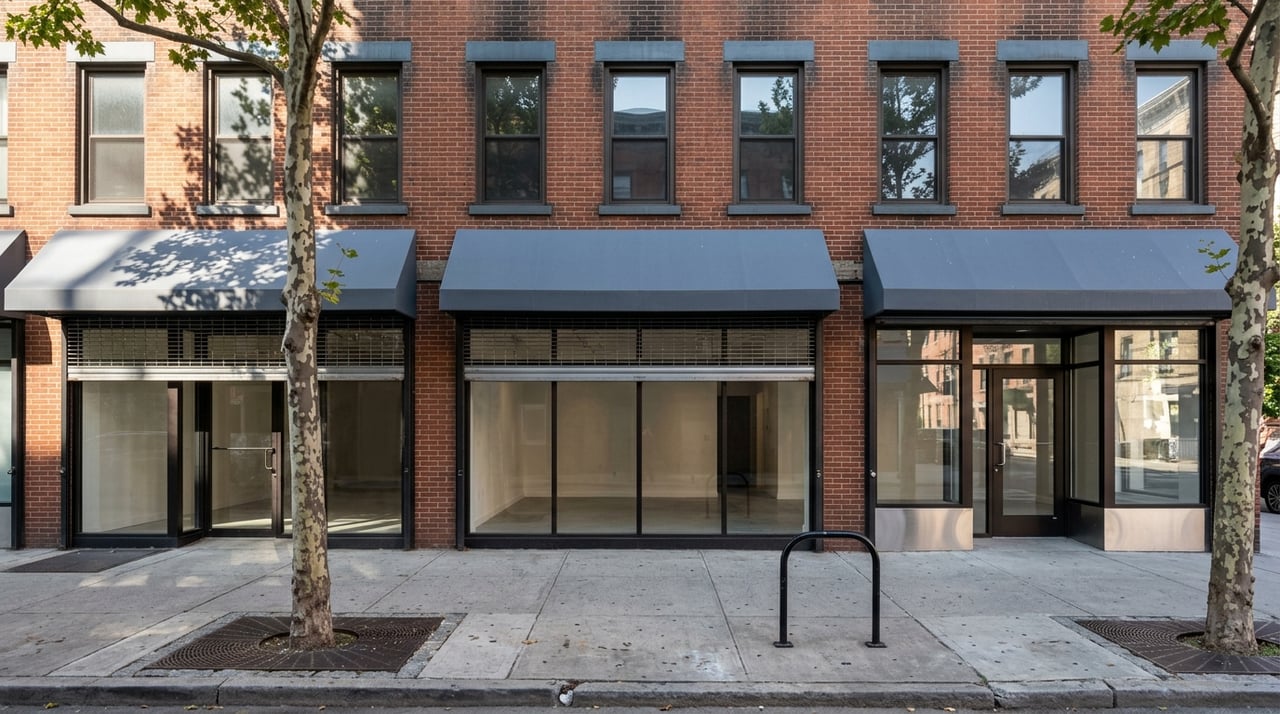
Storefront format matters too. In many Queens districts, small flexible spaces with strong frontage outperform larger boxes, while high-volume nodes can also support upper-floor services, vertical retail, and mixed-use centers.
How to think about Queens retail strategy
If you are evaluating retail in Queens, start with the trip pattern before you start with the map. Ask whether the corridor is driven by subway riders, bus riders, local residents on foot, or a mix that changes block by block.
Then look at the physical setup. Sidewalk width, storefront visibility, pedestrian comfort, and station adjacency can shape performance just as much as the surrounding demographics.
Finally, match the concept to the corridor instead of forcing the corridor to match the concept. In Queens, the strongest results often come from aligning use, format, and location with how people already move through the neighborhood.
For landlords, investors, and expanding tenants, that is where local market knowledge becomes valuable. A corridor can look strong on paper, but execution improves when you understand what type of retail the street actually supports and how that pattern changes from one stretch to the next.
If you are evaluating a retail corridor, repositioning a street retail asset, or planning a Queens expansion, Tide Realty Group brings a practical, borough-level view shaped by leasing, investment, finance, and operations.
FAQs
Which Queens retail corridor has the strongest transit-driven foot traffic?
- Downtown Flushing stands out, with the city describing it as having the heaviest foot traffic outside Manhattan and more than 20 public transportation options.
What makes Jackson Heights a retail corridor to watch in Queens?
- Jackson Heights combines dense neighborhood retail, five subway lines, seven bus routes, and high pedestrian counts, which supports food, beauty, convenience, and service uses.
Why is Jamaica important for Queens retail leasing?
- Downtown Jamaica sees roughly 560,000 daily pass-throughs and supports a broad mix of value retail, services, dining, and medical uses tied to major transit volume.
What type of retail fits Astoria’s commercial corridors?
- Astoria is generally well suited to restaurants, cafés, specialty food, fitness and wellness, personal services, and neighborhood comparison shopping across several walkable corridors.
Is Forest Hills more of a destination shopping corridor in Queens?
- Austin Street in Forest Hills is positioned as a regional shopping destination, with a mix of small shops, chain stores, and restaurants in a walkable setting.
What should tenants look for on Woodside’s Roosevelt Avenue?
- Tenants should pay close attention to station proximity, visibility, and sidewalk activity, since retail strength is highest near the Woodside transit hub and falls off in some stretches.
How is Bell Boulevard in Bayside different from other Queens retail corridors?
- Bell Boulevard appears more neighborhood-service and parking-aware than major transit-heavy corridors, making it a better fit for family dining, medical, and local service uses.