The headlines from May 2026 read like a civic press release: 880 affordable apartments open, ribbons cut, a 24,851-seat electric stadium rising next door. For mid-market investors underwriting retail strips on Roosevelt Avenue or a limited-service hotel near LaGuardia, the civic story is the wrong frame. The right one is that a single 23-acre parcel is quietly re-pricing demand assumptions that surrounding Queens submarkets have carried, largely unchallenged, for a decade.
The stadium is the story people are telling. The underwriting story is the 20,000 square feet of project-internal retail, the year-round event calendar, and roughly 1,100 new AMI-restricted households arriving inside a single transit-adjacent superblock.
Start with the friction: retail rollover math on Roosevelt and Northern
If you own a second-generation retail box within a mile of Citi Field, the near-term problem is not competition from Willets Point Commons itself. It is the co-tenancy re-rating that happens when a competing landlord can pitch a ground-floor space alongside 1,100 income-verified households, direct 7-train access, and a professional soccer tenant.
The immediate mechanics to work through before a 2026–2027 renewal cycle:
- Willets Point Commons opened with a full suite of ground-floor retail shops and community facilities, and the Phase 1 plan carries more than 20,000 square feet of neighborhood-serving retail once complete.
- Direct transit access via the 7-train, LIRR, and the Q19, Q90, and Q66 bus routes reshapes the effective trade area for any convenience-oriented tenant deciding between a Roosevelt Avenue inline space and a new build inside the project.
- Queens retail asking rents currently average roughly $45 per square foot marketwide, with Flushing-specific averages running materially higher. That spread compresses when a comparable-quality box opens two subway stops away with a captive residential base.
The transaction-specific friction is not vacancy. It is the leverage a Willets Point comp gives a tenant broker during a Flushing renewal negotiation eighteen months from now. Underwriting a 2027 rollover at trailing 2024 comps is the mistake to avoid.
The hotel demand curve is being smoothed, not just enlarged
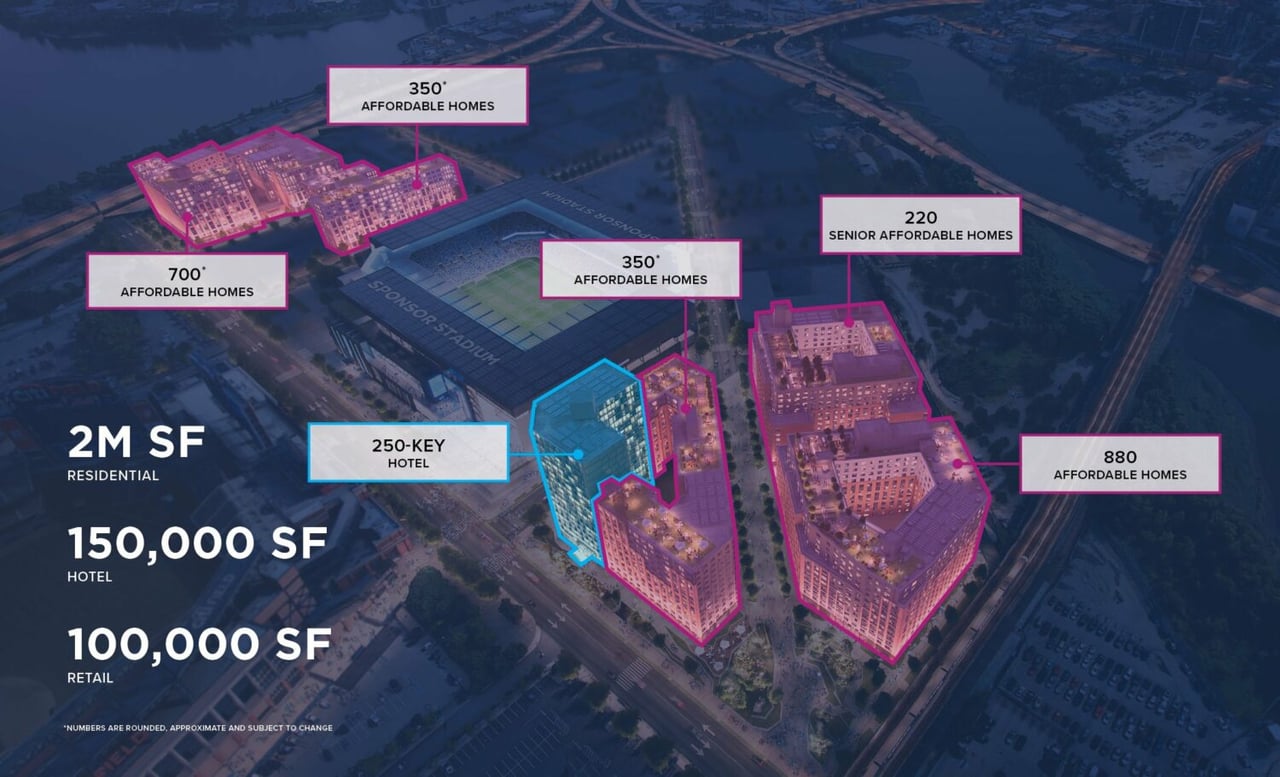
A 250-room hotel is entitled inside the Willets Point plan alongside the Etihad Park stadium. Most underwriting models treat a new project hotel as additive supply and stop there. The more useful question is what the combined event calendar does to seasonality.
Consider the calendar as it will exist by 2027:
Demand driver | Season | Ownership / operator |
|---|---|---|
New York Mets home schedule | Spring–fall | Sterling Equities affiliate |
NYCFC home schedule at Etihad Park | Summer–spring | NYCFC (opens 2027) |
US Open at the Billie Jean King National Tennis Center | Late August–early September | USTA |
Willets Point retail, school, and residential base | Year-round | QDG / NYCEDC |
Existing Flushing and LGA-adjacent hotels have historically underwritten a demand curve shaped by baseball, a two-week tennis spike, and business travel. NYCFC begins play at Etihad Park in the 2027 MLS season, layering a soccer calendar that runs opposite the baseball peak. As the Queens Daily Eagle observed on opening day, between Mets games played between the spring and fall, and NYCFC games played from the summer until the spring, residents of Willets Point will contend with cheering fans at major professional sporting events effectively year-round.
For a hotel underwriter, the read is not "more room nights." It is that shoulder-season occupancy at nearby product could stabilize in a way that changes both ADR strategy and refinancing coverage assumptions. The 250-room in-project hotel will capture the premium. The upside for existing owners is compression of trough months, not peak-day rate.
The supply side is delivering faster than the political timeline suggests
One reason to move now on repositioning decisions is that the delivery cadence has run ahead of every prior estimate for this site. Construction is complete on Willets Point Commons, two 12-story residential buildings in the first phase of the redevelopment of Willets Point, Queens, delivered by Queens Development Group, a joint venture between Related Companies and Sterling Equities, in partnership with HPD, HDC, and NYCEDC.
The next tranche is already under way. Construction has also begun on Building 3, which will add 220 affordable senior housing apartments and complete the 1,100-unit commitment for Phase 1. Phase 2 will deliver the remaining 1,400 units toward the 2,500-unit total, alongside the school, hotel, and open space program.
Etihad Park itself is vertical. As of December 2025, construction is rising on Etihad Park, the home stadium for Major League Soccer's New York City Football Club (NYCFC) at 126–87 Willets Point Boulevard in Willets Point, Queens, and the venue will be the first fully electric stadium in New York City and in MLS history.
Public infrastructure spend is reinforcing the district. Connect CRE reported in June 2026 that construction is proceeding on the $121-million Harper Street DOT administration building and yard redevelopment project at 32-11 Harper St. in the Willets Point section of Queens, replacing 160,000 square feet of 1934-vintage municipal facilities. Municipal capital of that scale, adjacent to a new residential district, generally precedes streetscape and utility improvements that lift surrounding assessed values.
NYCEDC frames the total impact as over 16,000 jobs as well as $6.1 billion in economic impact over the next 30 years. Treat the $6.1B figure as a directional political number, not an underwriting input. The delivery cadence is the underwriting input.
The resilience question competitors are glossing over
Any acquisition memo pitching Willets Point-adjacent upside should address one detail that rarely appears in the current coverage: the site sits inside a mapped flood zone. NYCEDC itself notes that with limited infrastructure and a history of environmental degradation, Willets Point is located within the 100-year flood plain. Related and the city have built out new water, sewer, and street infrastructure to support the project, which the area previously lacked.
For an investor underwriting a value-add play on an older Corona or East Flushing asset, the takeaway cuts two ways. Willets Point's remediation and new utilities improve the district's insurability profile. Older adjacent stock does not automatically benefit. Insurance carriers underwriting 2027 renewals will look at ground floor elevation, backflow protection, and NFIP zone individually. Budget for it in the capex line, not the assumption line.
Three questions to answer before you underwrite the adjacency premium
- Whose lease is up first? Map every retail and hospitality asset inside a ten-minute walk of the 7 train's Mets–Willets Point stop and calendar the 2026 to 2028 rollovers. That is the window where Willets Point comps will hit hardest before Phase 2 is delivered.
- What is the co-tenancy story in a term sheet dated summer 2027? A national tenant deciding between an existing Flushing inline and a new Willets Point ground floor will price the difference in dollars per square foot per foot-traffic assumption. Model both sides.
- How does dual-sport seasonality change your DSCR sensitivity? Rerun hotel and food-and-beverage pro formas with a smoothed shoulder-season occupancy assumption and stress-test the downside if NYCFC attendance underperforms opening-year projections.
FAQs
When does the Willets Point retail actually come online?
Willets Point Commons opened to residents in May 2026 with ground-floor retail bays inside the two delivered buildings. The larger neighborhood-serving retail program, including tenants sized to serve the full residential and stadium base, arrives with Phase 2 and the hotel. Underwrite the retail wave as a 2027 to 2029 event, not a 2026 event.
Does NYCFC playing at Etihad Park replace Yankee Stadium dates?
Yes. NYCFC begins its permanent home schedule at Etihad Park with the 2027 MLS season, which is the point at which the year-round Mets plus NYCFC calendar becomes fully operational for hotel and retail demand modeling.
Is the 2,500-unit affordable count fully committed?
The 2,500-unit total is the announced plan across Phases 1 and 2, with 1,100 units committed and either delivered or under construction inside Phase 1. Phase 2 unit counts are subject to the same public-private structure that delivered Phase 1 on the announced timeline.
The Willets Point transformation is being covered as a civic milestone. For owners and investors underwriting Queens retail, hospitality, and mixed-use assets in 2026 and 2027, it is a demand-curve event with a specific timeline attached. The differentiated returns will go to the sponsors who reprice their assumptions before the 2027 rollover cycle prints new comps, not after.
If you are evaluating a Queens acquisition, disposition, or repositioning against the Willets Point buildout, Tide Realty Group can model the specific submarket exposure and structure the transaction end to end. Rise With Us.