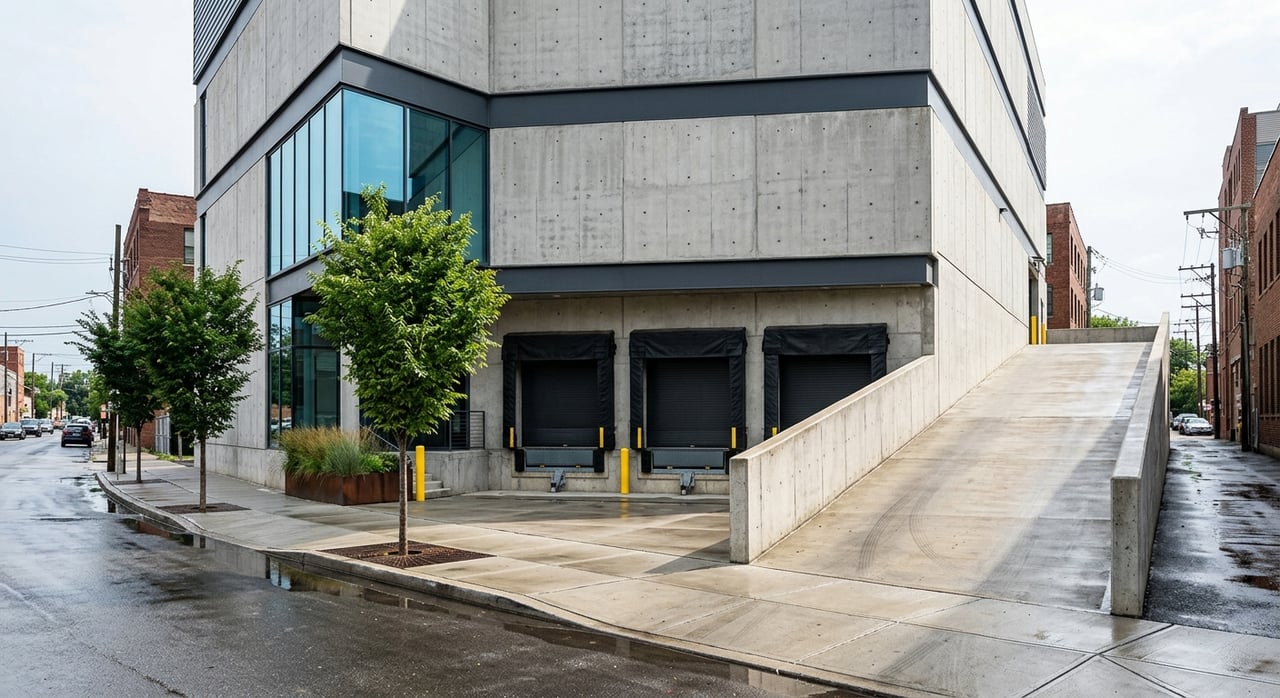
If you are weighing Queens against Brooklyn for a last-mile logistics facility, the answer is usually not about which borough is "better" in the abstract. It is about which operating model you need to support, how much space you need, and what kind of delivery network you are trying to serve. In New York City, those tradeoffs matter because new supply has been limited, zoning is evolving, and well-located industrial sites remain highly valuable. Let’s dive in.
What last-mile means in NYC
In New York City, parcel delivery facilities are a specific logistics use. The city describes them as warehouses used mainly to unload, sort, and reload pre-packed goods for final delivery, rather than for long-term storage.
That distinction matters because these facilities can create a different traffic pattern than traditional warehouse uses. City planning materials note that larger facilities can generate materially more traffic, which is one reason the city is moving toward a special-permit framework for some new facilities near residential and mixed-use areas.
For occupiers, investors, and owners, that means site selection is not just about rent or centrality. You also need to think about entitlement risk, truck movement, and how close a site sits to mixed-use edges.
Queens vs Brooklyn at a glance
At a high level, Queens tends to work better for larger-format logistics operations with stronger airport and highway access. Brooklyn tends to work better for dense urban delivery coverage, especially when your routes lean heavily toward Brooklyn and Manhattan.
That is the core tradeoff. Queens often wins on footprint efficiency and freight throughput, while Brooklyn often wins on end-user proximity and service radius.
Why Queens stands out
Queens favors larger footprints
One of Queens' clearest advantages is scale. The city's last-mile assessment says Queens had 19 parcel delivery facilities over 50,000 square feet totaling 5.25 million square feet.
The same assessment says Queens had larger facilities on average than Brooklyn and the Bronx. If your operation needs a bigger box, more loading, or more flexibility for vehicle circulation, that is a meaningful edge.
Queens has strong airport access
Queens benefits from direct ties to major air cargo infrastructure. NYC Planning says Eastern Queens is home to JFK Airport, the region's largest and busiest passenger and cargo airport, which moved 1.67 million tons of cargo in the referenced year.
The city's industrial plan also points to College Point and JFK Gateway as especially attractive for modern industrial investment because of their access to JFK, the Van Wyck Expressway, and the Whitestone Expressway. For operators moving time-sensitive freight, that access can materially shape operating efficiency.
Queens offers multiple logistics nodes
Queens is not a one-node story. NYC Planning identifies Long Island City and Maspeth as major clusters, and it notes that Northwest Queens benefits from highway access and proximity to LaGuardia Airport, Manhattan, and the Bronx.
The Grand Street Bridge adds another useful signal for freight movement. NYC DOT says the bridge spans the North Brooklyn and Maspeth Industrial Business Zones and carries about 11,400 vehicles per day, with roughly two-thirds traveling westbound into Brooklyn.
Queens has a deep industrial labor base
Queens also brings a substantial industrial employment ecosystem. Census QuickFacts estimates the 2025 Queens population at 2,358,182, while NYC Planning says Eastern Queens has 67.7k industrial jobs, representing 22% of private-sector employment in that planning area.
That same plan says 42% of industrial jobs in Eastern Queens are located in the Jamaica and JFK Gateway Industrial Business Zones. For firms that need access to a broad industrial workforce and an established logistics environment, that concentration is important.
Why Brooklyn stands out
Brooklyn is closer to dense demand
Brooklyn's biggest advantage is proximity to dense urban customers. With an estimated 2,653,963 residents in 2025, Brooklyn has the larger population base, and for many operators the borough also serves as a practical launch point into Manhattan delivery routes.
If your service model depends on shorter final-mile routes into dense neighborhoods and commercial districts, Brooklyn can reduce distance to the end user. That strategic proximity is often the main reason a Brooklyn location stays competitive despite tighter site conditions.
The BQE is Brooklyn's freight spine
For freight access, the Brooklyn-Queens Expressway remains central. NYC DOT describes the BQE as Brooklyn's only interstate highway and a vital freight corridor, with about 150,000 vehicles per day, including 13,000 trucks.
That makes the BQE a major operational asset for delivery networks centered on Brooklyn and Manhattan. At the same time, it also introduces congestion and infrastructure considerations that operators need to price into routing and scheduling.
Brooklyn has established industrial corridors
Brooklyn's industrial geography is also well defined. NYC Planning says South Brooklyn is one of the city's key maritime, production, and distribution hubs, anchored by Sunset Park, Red Hook, and Gowanus.
The same plan notes that these areas have long attracted maritime, production, utilities, and e-commerce uses because of their access to the working waterfront, the Verrazzano-Narrows Bridge, the BQE, and the Bay Ridge Branch. In North Brooklyn, industrial activity is centered in Williamsburg, Greenpoint, Bushwick, and the Brooklyn Navy Yard.
Brooklyn supports a large industrial workforce
Brooklyn's industrial labor pool is substantial, though more split across submarkets. NYC Planning says North Brooklyn has 37k industrial jobs and South Brooklyn has 37.6k industrial jobs.
It also states that 40% of North Brooklyn jobs and 56% of South Brooklyn jobs are located within their respective Industrial Business Zones. That supports a real operating ecosystem, but one that is more distributed across multiple corridors.
Inventory and space availability differences
A practical way to compare the boroughs is to look at existing large-facility inventory. Queens has 19 parcel delivery facilities over 50,000 square feet totaling 5.25 million square feet, while Brooklyn has 14 totaling 2.256 million square feet.
That gap suggests Queens offers more room for larger-format last-mile operations. Brooklyn's inventory is smaller and more concentrated, which can support strategic urban coverage but may limit flexibility for users seeking bigger modern footprints.
Zoning and entitlement considerations
Current zoning still allows many sites
Under current NYC zoning, last-mile facilities are generally treated as warehouses. They are generally permitted as-of-right in industrial districts including C8, M1, M2, M3, and MX.
The city also notes that new warehouses are generally not permitted in residential or most commercial districts except C8, while smaller micro-distribution facilities may be allowed in some commercial districts with size limits. That means the zoning map still matters more than a borough label.
Policy is moving toward tighter review
The city's draft last-mile text amendment is important for anyone planning a new facility. It signals movement toward tighter review of future last-mile development near residential districts and mixed-use areas.
That does not mean Queens or Brooklyn is off the table. It does mean location strategy should account for how close a site is to residential adjacency, mixed-use boundaries, and other planning sensitivities.
Building replacement can be hard
NYC Planning's draft industrial plan adds another challenge. It says 96% of M-zoned land is capped at 2.0 FAR, with rules that often push low-density building forms and impose parking, loading, and sky-exposure constraints.
In practice, that can make it difficult to replace older industrial stock with more efficient modern logistics product. For users who need immediate occupancy or a realistic redevelopment path, that limitation should stay front and center.
Cost matters, but rent is not the whole story
Industrial space in New York City remains expensive and scarce. The city's industrial plan says citywide industrial asking rents were about $25 per square foot in Q1 2025, and it notes that newer industrial space averaged over $30 per square foot.
Other market sources cited by the city reported outer-borough industrial asking rents of $27.64 per square foot in Q3 2025 and $28.93 per square foot in Q2 2025. The key takeaway is simple: quality urban industrial space commands premium pricing.
Still, occupancy cost is not just base rent. Your total cost also includes taxes, circulation efficiency, labor access, and whether a building actually fits your operation without major retrofits.
Incentives can affect the math
For some users, incentives can help offset costs. NYC Business says the IBZ Relocation Tax Credit provides a one-time credit of $1,000 per relocated employee, capped at $100,000, and it applies in both Brooklyn and Queens Industrial Business Zones.
NYC Business also says ICAP can provide property-tax abatements for up to 25 years for industrial and commercial buildings that are updated, expanded, or improved. The Commercial Expansion Program is also available in offices and industrial spaces across Brooklyn, Queens, the Bronx, and Staten Island.
These programs will not change a poor location into a good one. But for the right site, they can improve feasibility and shift the economics of relocation, expansion, or repositioning.
A practical framework for choosing
If you are deciding between Queens and Brooklyn, it helps to frame the decision around your operating priorities.
Choose Queens if you need:
- Larger building footprints
- Better truck circulation
- Strong airport cargo adjacency
- Direct access to JFK-linked corridors
- More operational flexibility for regional distribution
Queens generally fits operators that are optimizing for throughput, vehicle movement, and larger-format space.
Choose Brooklyn if you need:
- Tighter proximity to Brooklyn and Manhattan deliveries
- Access to established waterfront industrial corridors
- Strong bridge and BQE connectivity
- A location closer to dense end-user demand
Brooklyn generally fits operators that are optimizing for service radius and urban delivery proximity.
The bottom line
For many last-mile users, Queens is the more operationally flexible borough. Its larger average facility size, stronger airport connections, and broader large-box inventory make it a logical choice for truck-intensive distribution models.
Brooklyn, however, can be the stronger strategic fit when your network depends on staying close to dense customer demand in Brooklyn and Manhattan. Its industrial corridors are proven, its freight spine is established, and its value often comes from urban proximity rather than footprint efficiency.
The right answer depends on what you are optimizing for: truck economics or final-mile service radius. If you are evaluating sites, underwriting a repositioning, or comparing industrial corridors across boroughs, Tide Realty Group can help you align location strategy, execution, and long-term asset performance.
FAQs
Is Queens or Brooklyn better for large last-mile logistics facilities?
- Queens generally has the edge for larger last-mile facilities because it has more facilities over 50,000 square feet, more total large-facility square footage, and stronger airport-linked freight access.
Why do some operators still choose Brooklyn for last-mile logistics?
- Brooklyn can be a better fit when delivery routes depend heavily on serving dense Brooklyn and Manhattan demand, especially near established industrial corridors and the BQE.
Are last-mile logistics facilities allowed as-of-right in Queens and Brooklyn?
- In many industrial districts, yes. NYC zoning generally treats these facilities as warehouses and permits them as-of-right in C8, M1, M2, M3, and MX districts, though future projects near residential and mixed-use areas may face tighter review.
How much industrial space exists for parcel delivery in Queens versus Brooklyn?
- NYC's assessment says Queens has 19 parcel delivery facilities over 50,000 square feet totaling 5.25 million square feet, while Brooklyn has 14 totaling 2.256 million square feet.
Do tax incentives apply to logistics facilities in Queens and Brooklyn?
- They can. NYC Business lists the IBZ Relocation Tax Credit for eligible relocations in both boroughs' Industrial Business Zones, and it also notes programs such as ICAP and the Commercial Expansion Program that may improve occupancy economics.